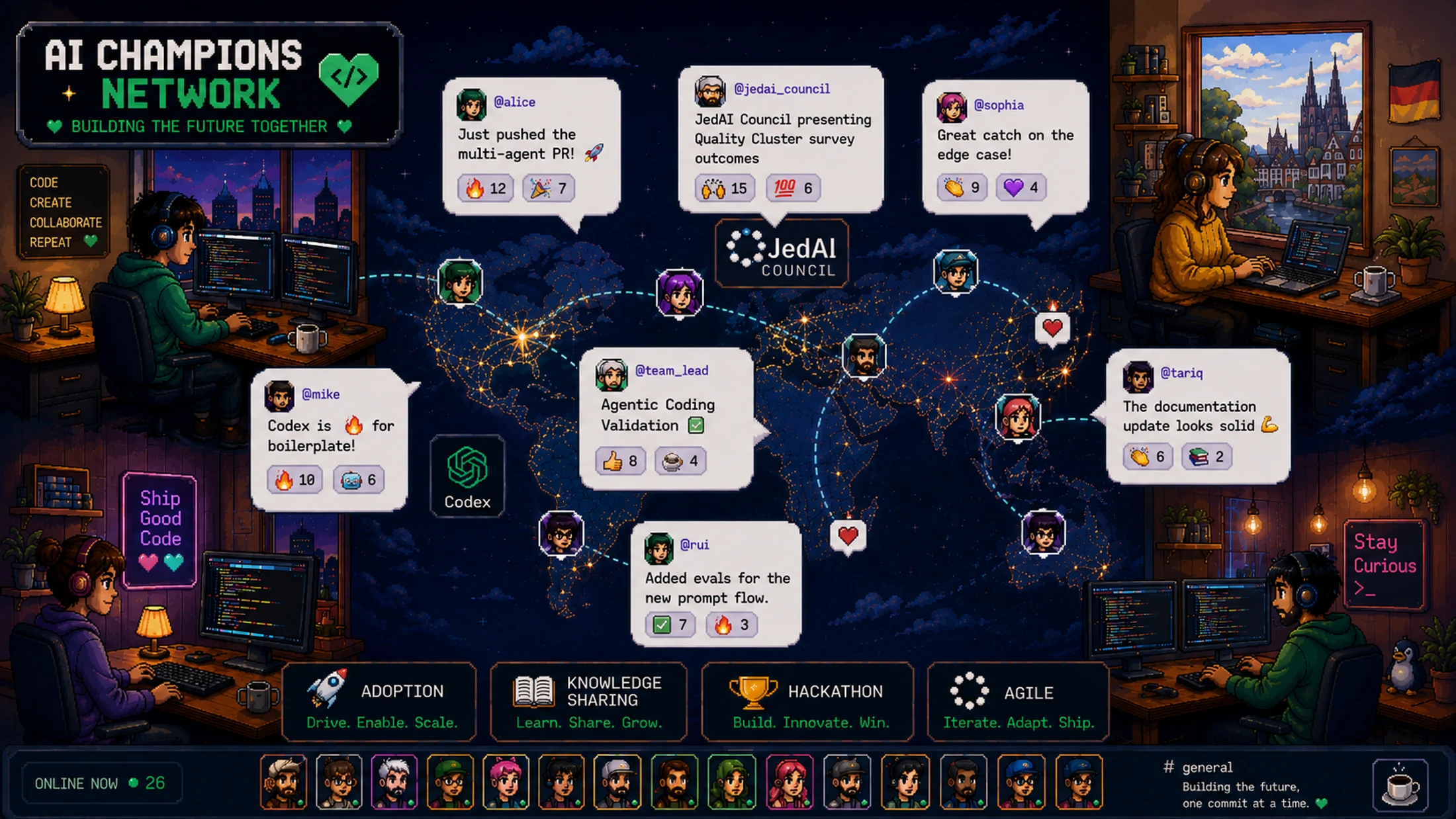
The AI Champions Network
Marcia Stipanich Martins · June 18, 2026 · 4 min read


At AutoScout24 and its companies, engineers are doing genuinely interesting things with AI. A team would figure out a workflow that saved them hours. Another would test a tool, hit its limits, develop a real opinion about it. How do you make this scalable and efficient, in a way that allows those outcomes to cross team boundaries?
In a world with 100 great ideas, how do you filter and scale the best ones?
That’s why the AI Champions Network was born. It goes beyond an AI community — it is an engineering mechanism to turn isolated experimentation into shared, reusable progress.
Finding the Right People
We started this network by asking leaders: who was already a pioneer on each of their local AI journey? I wanted a group small enough to have a real conversation and big enough to cover different time zones, systems and team realities. We ended up with roughly one person per team: an AI Champion.
“Not a role you get assigned because you have spare time, but a role you grow into because you’re already doing something like it.”
Defining what that means was harder than I expected. And we had to experiment and iterate a couple of times to arrive on the perfect blend. The challenge was beyond finding a local “AI influencer” — we had to establish this across tech stacks, with a profile that not just loves experimenting things, but is not afraid to fail in front of others.
This person must be passionate about AI with technical depth, while also having great judgment and the ability to sit with uncertainty, try things that might not work, and still turn that into something useful for others. This is someone to write a recipe, not follow them.
The JedAI Council
We gave the network a simple rhythm. Regular meetings we call the JedAI Council — yes, that’s the real name, and the name is part of the point. It cannot feel like a status update meeting, or nobody will want to be there.
In the Council, champions share what they’re seeing: what tools they’re running, where they’re getting stuck, what surprised them this week, sometimes questions or even feedback prior to a PR.
From this big group, I’ve split them into clusters for even more dynamic exchange. When they’re back, they bring rich summaries — and sometimes, cross-cluster collaboration happens for finding synergy.
What Made It Work
Making an organization grow in maturity requires creating this rhythm of connect, experiment, shape and share, iterate. I’ve observed key elements that made this a success factor for the network:
1. Transparency
Having everything shared — from agenda to results of conversations. It gives anyone the ability to catch up and helps spread the word. It gives rich context, from onboarding to feeding LLMs; giving us suggestions of what’s next. This is the key element to make something local become scalable.
2. Real Life
A screenshare worth a thousand words. In the age of AI, investing time on polishing presentations when we all can understand a screenshare is a waste of time and energy. Being in these meetings feels real because it is real.
3. People Aspects
When it comes to spreading the culture of AI, the people behind it are the real assets. Champions became the reference for AI across the org. We established a quarterly award called “The Force Multiplier” — as they literally multiply AI’s voice across the org. And rotation gives opportunity for others while allowing for seasonality of each business to play.
What Came Out of It
Many concrete things came out of the network. This isn’t abstract — these are real deliverables, built by the Champions themselves:
- Evaluation: A coordinated review of AI coding assistants — a map of where each tool worked, where it didn’t, and why.
- Standards: A standard for Agents, automated documentation updates, a security reviewer, and standardized context guidance.
- Training: Cross-org trainings recorded by Champions — on real AutoScout24 code, running into real AutoScout24 constraints.
- Hackathons: Champions supported numerous hackathons, providing knowledge and guidance for other teams to explore AI.
The effect on engineers — watching a training made by a co-worker, on code they recognize, running into the same constraints they hit — brings learning to another level. That’s applied understanding no external course can replicate.
Scaling AI inside an organization isn’t mainly about picking the right tools or great talent alone. A lot of companies are fine at that. The harder part is building the internal mechanisms that let real interaction happen — learning move across teams, across domains, across the invisible organizational boundaries.